2026 Goal Mapping Journal: A Realistic Guide to Turning Intentions Into Daily Progress
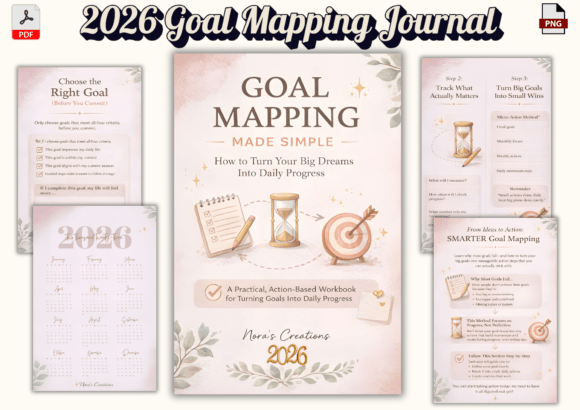
There is a quiet gap between setting a goal and actually reaching it. Most planners look impressive on the shelf but leave you stranded after the first week of enthusiasm fades. The 2026 Goal Mapping Journal tries to close that gap by focusing less on motivation and more on structure. It is a 40-page digital download in PDF and PNG formats, sized at 6×9 inches, built around an action-based SMARTER goal planning system. The idea is not to make you feel inspired for a day, but to give you something you can follow when inspiration runs out.
What makes this workbook different is how it handles the messy middle — that long stretch between starting and finishing where most people drop off. Instead of asking you to write big dreams and hope for the best, it walks you through micro-actions, obstacle planning, and realistic deadlines. It assumes you have low-energy days, unexpected interruptions, and moments of doubt. And it builds a system around those realities rather than pretending they do not exist.
Where and When This Workbook Fits Into Real Life
You might be sitting at your desk on a Tuesday evening, staring at a list of things you wanted to accomplish this year but have not touched since February. Or maybe you are a freelancer juggling multiple projects, and you need a way to track progress without adding more mental clutter. The 2026 Goal Mapping Journal fits into those moments because it is not another app notification or a complicated spreadsheet. It is a straightforward PDF you can open on your tablet, print out, or keep in a folder on your laptop.
One of the most practical uses is during a quarterly reset. You finish a big project, or maybe you just survived a chaotic month, and you need to sit down and figure out what actually matters next. The workbook gives you a structured way to do that without falling into the trap of setting five new ambitious goals that you will abandon after two weeks. The goal selection decision filters help you cut through the noise and pick only what deserves your limited time and energy.
Another scenario is the weekly review. You have your execution planner open, you check off what moved forward, you notice where you got stuck, and you adjust. The workbook includes a progress tracking adjustment system that does not feel like homework. It feels like a conversation you have with yourself about what is working and what is not. That alone can save you weeks of spinning your wheels.
How Creators and Entrepreneurs Actually Use This
If you run a small business or work as a creator, you already know that motivation is unreliable. You cannot build a business on days when you feel like it. The 2026 Goal Mapping Journal appeals to people who need systems because they have too many ideas and not enough follow-through. Imagine you are a freelancer who wants to launch a digital product by mid-year. You have the skills, you have the audience, but you keep getting distracted by client work and new shiny ideas.
This workbook helps you break that launch into micro-actions. Instead of a vague goal like launch the course, you define the clear outcome, you map the steps by week, and you plan for the obstacles you already know will show up — like a client emergency or a week when your energy is low. The micro-action breakdown pages force you to be specific about what you will do today, not just what you hope to do someday.
For bloggers and content creators, the workbook works well as a content planning companion. You can use the timeline mapping section to plan a series of posts around a theme, and the weekly execution planner keeps you accountable without the guilt of missed days. It is not about perfection. It is about showing up enough times that the work adds up.
Personal Growth and Life Reset Use Cases
Not every goal is about business. Many people who download the 2026 Goal Mapping Journal are working on personal things — building a consistent exercise habit, learning a new skill, or finally decluttering their living space. These goals often feel abstract because they do not have external deadlines. No boss is asking for a report on your reading habit. So it is easy to let them slide.
The workbook handles this well by making those personal goals tangible. You use the clear outcome definition measurement tools to decide what success actually looks like. Maybe it is reading 12 books this year, or running twice a week without skipping for three months. Once you define it clearly, the micro-action breakdown helps you design the smallest possible version of that habit. One page. Ten minutes. A single repetition. That is how real consistency starts, especially when you are doing it for yourself and no one else is watching.
I have seen people use the workbook after a major life transition — a move, a career change, or the end of a long project. Those moments are disorienting, and it is tempting to either set too many goals or avoid setting any at all. The goal selection decision filters help you ask the right questions: Does this goal actually matter right now? Do I have the capacity for it? What would I need to let go of to make room? That kind of honest filtering is rare in most planners, but it is built into this one.
Why the SMARTER Framework Works When Others Do Not
You have probably seen SMART goals before — Specific, Measurable, Achievable, Relevant, Time-bound. The 2026 Goal Mapping Journal uses a SMARTER version that adds Evaluate and Readjust. That extra step changes everything because it acknowledges that your first plan will not be your final plan. Life changes. Priorities shift. Energy fluctuates. The real-life obstacle planning pages anticipate those shifts and help you build contingency into your goal, rather than treating every obstacle as a failure.
For example, let us say you are a small business owner aiming to increase your revenue by 20% in the first half of the year. A traditional planner might have you write that down and break it into monthly targets. This workbook asks you to think about what could go wrong — a supplier delay, a slow season, a health issue — and plan your response ahead of time. That is not pessimistic. It is realistic. And it keeps you moving forward when things do not go perfectly.
The completion reflection learning capture pages at the end are also worth mentioning. Most people finish a project and immediately jump into the next one without pausing to learn anything. This workbook forces a pause. What worked? What did not? What would you do differently? That kind of reflection compounds over time and makes each subsequent goal easier to achieve.
What to Consider Before Using This Workbook
No tool works for everyone, and the 2026 Goal Mapping Journal is no exception. The strength of this workbook is its structure, but that same structure might feel restrictive if you prefer completely freeform journaling. The pages guide you through specific steps, prompts, and layouts. If you are someone who hates being told what format to write in, you might find it confining. That said, the workbook does include notes and free planning pages, so there is room for flexibility.
Another thing to consider is the digital format. You receive PDF and PNG files, which means you need a device to view them or a printer to use them physically. If you prefer a bound notebook, you will need to print the pages and put them in a binder. The 6×9 inch size is compact enough to carry around, but it is worth knowing upfront that this is a download, not a physical book. For many people, that is actually a benefit — they can reprint pages, use it on their iPad, or store it in cloud folders without adding physical clutter. But if you love the tactile feel of a spiral-bound journal, you will want to print it on good paper and bind it yourself.
Also, consider your goal load. The workbook is designed for focused goal setting, not for tracking every single thing you want to do this year. If you have 20 goals in mind, the decision filters will help you narrow down to what actually matters. But if you refuse to let go of any of them, you might find the workbook frustrating. It asks you to choose. And choosing is hard. But it is also necessary if you want to avoid burnout.
Who Gets the Most Out of This Workbook
Based on how the 2026 Goal Mapping Journal is structured, it works best for people who are tired of starting over. If you have set goals before, abandoned them, felt guilty, and then set them again in a cycle that never leads anywhere, this workbook is designed to break that pattern. It is also useful if you are someone who has clarity about what you want but struggles with the execution side. The weekly execution planner and micro-action breakdown give you a template you do not have to invent from scratch.
Educators and coaches might find it useful as a tool to share with students or clients who need help with follow-through. Hobbyists who want to make consistent progress on a side project — learning an instrument, writing a novel, building a garden — will appreciate the timeline mapping and obstacle planning. Marketers and publishers who plan content calendars or product launches can adapt the framework for team goals as well as personal ones.
The workbook does not require any special skills to use. It walks you through each section with prompts and examples. The language is calm and practical, not hype-driven. There are no motivational quotes plastered on every page. Just space to think, plan, and adjust. That quietness is intentional. It creates room for you to hear your own thoughts instead of being shouted at by the planner.
Small Details That Make a Difference
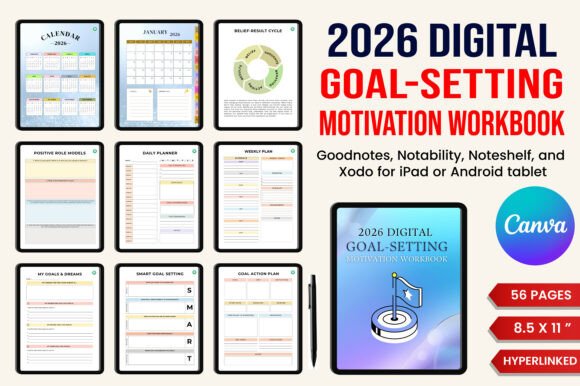
The 40 pages include a mix of guided worksheets and open journaling space. Some pages ask you to write your goal in detail, others ask you to list obstacles, and others give you a simple weekly grid to check off actions. The variety prevents the workbook from feeling repetitive. You move from big-picture thinking to small daily steps and back again. That rhythm helps you stay connected to your purpose without losing sight of what you need to do today.
The PDF and PNG formats mean you can use the workbook on different devices or print specific pages repeatedly. If you want to reuse the weekly execution planner every week, you can print that single page as many times as you need. The 6×9 inch size also means it prints easily on standard letter or A4 paper with minimal trimming. For anyone who has dealt with poorly formatted digital planners, that attention to practical detail matters.
Ultimately, the 2026 Goal Mapping Journal is not trying to be the only planning tool you will ever need. It is trying to be the tool that helps you actually finish what you start. And in a world full of distractions, unfinished projects, and good intentions that never turn into action, that is a genuinely useful thing to have. Whether you use it for work, personal growth, or a little bit of both, the value comes from showing up to the pages regularly and letting the structure do the heavy lifting on the days when you do not have the energy to figure it out yourself.