2026 Finance Planner – A Strategic Tool for Clearer Financial Decisions
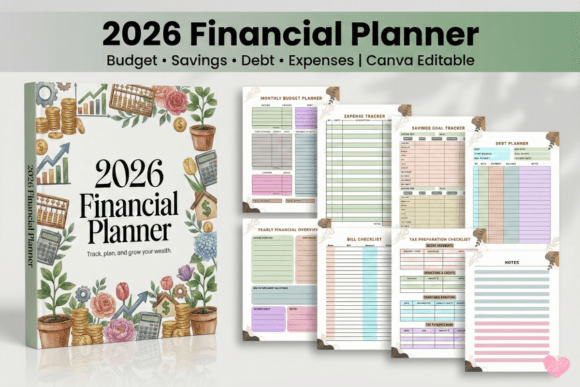
Budgeting and financial planning often feel like tasks you should do rather than something that genuinely helps. Yet when you step back and look at how money flows through a business, a side project, or a household, the real challenge is rarely about earning more. It is about knowing where your money goes, what it supports, and whether your spending aligns with what matters most. The 2026 Finance Planner is designed to address exactly that gap. It gives you a structured, flexible system to track income, expenses, savings, and debt without forcing you into a rigid format that does not fit your life.
What makes this planner strategically useful is not the number of pages or the design alone. It is the fact that every part of it can be customized in Canva. You can adjust layouts, colors, fonts, and even the categories themselves. That level of control matters because your financial situation is unique. A freelancer’s budget looks different from a small business owner’s, which looks different from someone managing a household while building a side business. The 2026 Finance Planner adapts to those differences rather than pretending one template fits all.
Why Strategic Financial Planning Demands More Than a Spreadsheet
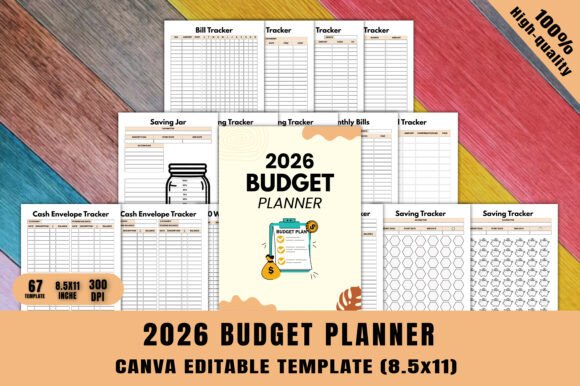
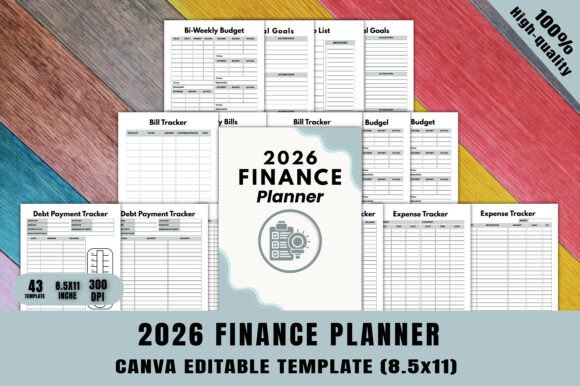
Spreadsheets are powerful, but they require you to build the structure yourself. Many people start with good intentions, create a few columns, and then abandon the file by February because maintenance feels like a second job. The 2026 Finance Planner removes that friction. It provides pre-built pages for monthly budgets, bi-weekly budgets, paycheck budgets, bill tracking, expense tracking, income tracking, debt payment tracking, and savings goals. Instead of deciding how to organize your finances, you can focus on the actual decisions: what to cut, what to fund, and where to adjust.
From a decision-making standpoint, having a consistent format across the entire year helps you compare months directly. You can see whether your grocery spending increased in March or whether your freelance income followed a predictable pattern. That type of pattern recognition is difficult when you jump between different tools or rely on memory alone.
Another strategic advantage is the 50-week savings tracker and the saving jar page. These are not just motivational gimmicks. They create a visual feedback loop. When you track progress weekly, you reinforce the habit of saving rather than treating it as a one-time resolution. People who track their savings in smaller increments tend to stick with the practice longer, and this planner makes that tracking almost effortless.
How the 2026 Finance Planner Supports Clear Goals and Better Outcomes
Financial planning only works when it connects to something you actually want. Without a goal, a budget feels like deprivation. The 2026 Finance Planner includes pages for financial goals, a summary of the year, and a holiday budget, which help you tie your daily tracking to larger objectives. Suppose you want to pay off a specific debt by June. The debt payment tracker pages let you break that goal into monthly and weekly steps, and the summary page gives you a place to review progress at the end of the year.
For entrepreneurs and creators, this planner also works as a communication tool. If you run a business with a partner or manage finances alongside a spouse, having a clear, shareable document reduces misunderstandings. You do not have to explain why money was spent a certain way. The planner shows it. That transparency builds trust and reduces the emotional friction that often surrounds financial discussions.
In a practical sense, you can use the planner to test assumptions. For example, if you think you spend about $400 per month on dining out, the expense tracker will confirm or challenge that belief within two months. That kind of data changes how you plan. Instead of guessing, you base your next budget on actual behavior. Over the course of a year, small corrections compound into significant savings or debt reduction.
When and How to Approach the 2026 Finance Planner
Timing matters. Starting a planner in January is natural, but there is no rule that says you cannot begin in any other month. The 2026 Finance Planner includes a monthly planner from January to December, so if you pick it up in March, you can skip the earlier months or backfill them from memory. What matters more than the start date is the routine you build around it. Setting aside 15 minutes each week to update the relevant pages is more effective than trying to fill in an entire month at once.
Consider using the planner in two phases. First, fill out the fixed pages like account details, financial goals, and the annual finance overview. These provide context for everything else. Then, as the year progresses, update the monthly budget, expense tracker, and debt payment pages. At the end of each quarter, review the summary pages to see whether you are on track. This phased approach prevents overwhelm and keeps the planner focused on what matters right now.
If you are a KDP publisher or a creator who sells planners, this same file becomes a product you can customize and sell. The editable Canva template means you can rebrand it, change the cover, adjust the instructions, and publish it under your own brand. That is a practical use case for entrepreneurs who want to enter the printable planner market without designing every page from scratch.
Practical Examples of Using the Planner Intentionally
Let us walk through a few realistic scenarios. Imagine you are a freelancer with irregular income. The paycheck budget page becomes your starting point. You estimate your lowest monthly income and build your fixed expenses around that number. Then, in months when you earn more, you allocate the surplus toward debt repayment or savings using the income tracker and saving jar pages. The bi-weekly budget helps you manage cash flow between payments, which is often the trickiest part of freelancing.
Now consider a small business owner who needs to separate personal and business expenses. You can use one 2026 Finance Planner for personal finances and a second copy for business. The bill tracker and monthly bills pages keep due dates visible, and the expense tracker gives you a record for tax purposes. At the end of the year, the summary page provides a high-level view of your business spending, which helps when you plan for the next year.
For someone focused on debt reduction, the debt payment tracker is the most valuable section. You list each debt, track payments monthly, and watch the balance decrease. The visual progress reduces the psychological weight of debt because you see that the number is moving in the right direction. Combined with the 50-week savings tracker, you can simultaneously build an emergency fund so that an unexpected expense does not push you back into debt.
What to Consider Before Relying on Any Financial Planner
No planner, no matter how well designed, replaces the need for honest evaluation. The 2026 Finance Planner is a tool, not a solution. If you fill it out without reviewing what the numbers mean, you are just collecting data without insight. The risk is that you go through the motions of tracking without changing any behavior. That is why the summary pages and financial goals section exist. They force a moment of reflection.
Another risk is overcomplicating the system. With 43 unique pages, it is tempting to track everything. But if you try to fill every page every week, the planner becomes a chore. A better approach is to choose the pages that align with your current priorities. If savings is your main goal, focus on the savings tracker, saving jar, and 50-week tracker. If debt is the priority, use the debt payment tracker and the monthly budget. The other pages remain available if your focus shifts later in the year.
Consistency also matters more than perfection. If you miss a week, just pick up where you left off. Do not abandon the entire planner because of one gap. The goal is long-term awareness, not flawless record-keeping.
Long-Term Value of Using a Customizable Finance Planner
What makes the 2026 Finance Planner useful beyond one year is the habit it builds. After using it for twelve months, you develop a clearer sense of your spending patterns, income cycles, and financial blind spots. That knowledge stays with you even if you switch to a different system later. The planner trains you to think in terms of categories, timelines, and trade-offs rather than vague hopes.
For creators and publishers, the customizable nature of this product also builds long-term value. You can update the design each year, offer it as a free lead magnet, or bundle it with other printables. Since you control the Canva template, you are not locked into a specific look. You can adapt it to different niches, languages, or branding styles. That flexibility makes it a repeatable asset rather than a one-time product.
From a decision-making perspective, the real payoff comes when you look back at a full year of data. You see what worked, what did not, and where you drifted from your original plan. That retrospective view is difficult to get without a consistent tracking system. The 2026 Finance Planner provides exactly that structure, but it leaves the difficult work of judgment and adjustment where it belongs: with you.
Whether you use it for personal finance, business operations, or as a product to publish, the value lies in how honestly you engage with it. Fill it out, review it regularly, and let the numbers inform your next move. That is the difference between planning and simply documenting.