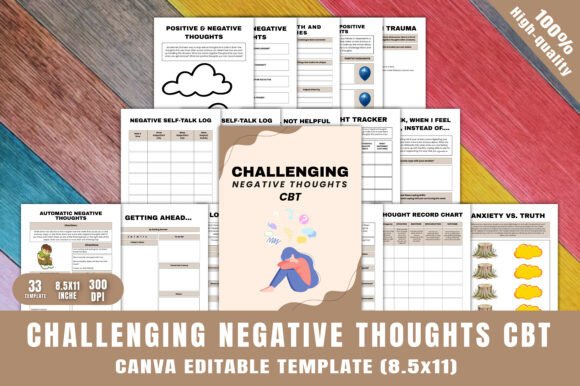
Challenging Negative Thoughts with CBT: A Practical Framework for Mental Wellness
Cognitive Behavioral Therapy (CBT) is one of the most well-researched and effective approaches for managing negative thinking patterns. At its core, CBT rests on a simple but powerful idea: your thoughts shape your emotions and behaviors, and by changing how you think, you can change how you feel and act. The Challenging Negative Thoughts CBT workbook provides a structured, repeatable system for applying this principle in daily life, whether you are a professional managing workplace stress, a creator working through creative blocks, or an educator supporting students and yourself.
What Makes the Challenging Negative Thoughts CBT Approach Different
Many self-help resources offer vague advice about "thinking positively" or "staying optimistic." The Challenging Negative Thoughts CBT methodology is different because it is process-oriented and evidence-based. Instead of asking you to simply suppress negative thoughts, it teaches you to identify, examine, and reframe them using concrete techniques. This is not about blind positivity; it is about accuracy, perspective, and informed decision-making.
The workbook interior includes 33 unique pages designed to guide you through this process systematically. From the Automatic Negative Thoughts (ANT) identifier to the 5 Steps to Untwisting Your Thinking, every page serves a specific function in the cognitive restructuring workflow. This makes it suitable for anyone who values clarity, consistency, and measurable progress in their mental wellness routine.
Where CBT Fits in Your Workflow
One of the most useful features of the Challenging Negative Thoughts CBT framework is its flexibility. It can be integrated before, during, or after almost any activity—professional or personal. Here is how it fits into common workflows:
Before a Project, Decision, or Creative Session
Negative thoughts often appear before we even begin. Anticipatory anxiety, imposter syndrome, and fear of failure can stall momentum before you start. Using the workbook pages such as "Identify Your Automatic or Troubling Thought" and "Be a Detective" allows you to surface these thoughts early, examine their validity, and replace them with more balanced alternatives. This clears mental clutter before you invest time and energy into the work.
During a Task or Learning Activity
When you are in the middle of a challenging task—whether writing a report, learning a new skill, or launching a product—negative self-talk can derail focus. Pages like "Positive Self-Talk Log" and "Helpful vs. Not Helpful" help you catch these thoughts in real time. This is especially useful for entrepreneurs and freelancers who work alone and lack external validation. The "Thought Tracker" provides a quick way to log recurring patterns without breaking your workflow.
After a Setback, Mistake, or Difficult Interaction
Post-event rumination is one of the most common sources of distress. The "Looking Back" and "Looking Forward" pages are explicitly designed for this. They help you process what happened, separate fact from interpretation, and extract actionable lessons without spiraling into self-criticism. This turns a negative experience into a learning opportunity that improves future outcomes.
Practical Implementation Tips for Daily Use
To get the most out of the Challenging Negative Thoughts CBT workbook, treat it as a practice rather than a one-time exercise. Consistency matters more than duration. Even five minutes a day with one page can shift your cognitive habits over time.
- Start with the ANT page. Automatic Negative Thoughts are the foundation. Spend a week just noticing and logging them without judgment. This builds awareness, which is the prerequisite for change.
- Use the 5 Steps to Untwisting Your Thinking when you notice a recurring negative pattern. Steps like examining the evidence, considering alternative perspectives, and looking for cognitive distortions are directly applicable to work-related stress, relationship concerns, and creative blocks.
- Pair the "Thought Record Chart" with your calendar. Choose one time of day—morning, midday, or evening—to fill it out. Consistency makes the process habitual, so it becomes automatic over time.
- Customize the pages to your context. Since the workbook is fully editable in Canva, you can adjust prompts, rename columns, or add your own examples. A marketer might replace generic thought examples with industry-specific ones. A therapist or educator can adapt the language for clients or students.
How the Workbook Interacts with Other Tools and Methods
The Challenging Negative Thoughts CBT workbook is not meant to exist in isolation. It works well alongside established productivity and wellness practices:
- Journaling: Use the "Negative vs. Positive Thoughts" and "My Strengths and Qualities" pages as journaling prompts. They provide structure without restricting creativity.
- Goal Setting: The "Looking Forward" page pairs naturally with quarterly or monthly goal reviews. It helps you identify mental barriers before they block progress.
- Coaching or Therapy: The workbook serves as a valuable between-session resource. Clients can bring completed pages to sessions, giving the practitioner concrete material to work with.
- Team or Group Work: Educators and team leaders can use the "Positive Self-Talk" or "Detective Practice" pages as group exercises. Sharing insights in a safe environment normalizes the experience of negative thinking and reduces stigma.
Preparation and Customization for Long-Term Use
Because the workbook comes with editable Canva templates, you have full control over how it looks and functions. This is especially important for professionals who want to maintain brand consistency or tailor content for specific audiences. Here are a few practical considerations:
- Choose your format early. The download includes print-ready PDF, high-resolution JPG, and PNG files, plus the editable Canva link. If you plan to use it digitally with a tablet and stylus, the PNG files work well. For physical journaling, the PDF prints cleanly on standard paper.
- Adjust frequency and pacing. Not every page needs to be used every day. You might use "Coping with Trauma" and "Anxiety vs. Truth" during high-stress periods, while "Positive Self-Talk Log" and "Negative Self-Talk Log" can be weekly check-ins.
- Build a library of completed pages. Over weeks and months, these pages become a personal reference library. You can review your "Thought Record Chart" from previous months to see patterns and growth. This supports long-term self-awareness and reinforces the CBT process.
Maintaining Consistency and Quality in Your Practice
Like any meaningful practice, challenging negative thoughts requires consistency to deliver results. Here are a few observations from people who have integrated CBT workbooks into their routines:
- Start small. Use one page per day for the first two weeks. The "This Book Belongs To" page is a gentle starting point that establishes ownership and intention.
- Use natural triggers. Pair workbook time with an existing habit, such as drinking morning coffee or winding down before bed. This reduces the mental effort required to remember.
- Variety prevents boredom. The 33 unique pages give you enough variety to avoid monotony. Rotate between structured exercises like "Detective Practice" and reflective ones like "Positive Self-Talk" to keep the practice fresh.
- Review your progress monthly. Set aside 15 minutes at the end of each month to flip through completed pages. Notice which thought patterns recur and which exercises felt most useful. This meta-awareness itself is a CBT skill.
Who Benefits Most from This Approach
The Challenging Negative Thoughts CBT workbook is designed for a broad audience, but certain groups will find it especially valuable. Professionals in high-pressure roles—entrepreneurs, marketers, freelancers—often face persistent doubt, perfectionism, and fear of failure. The structured pages give them a concrete way to process these feelings without relying on external support. Educators and therapists can use the workbook as a scalable resource for clients or students who need guided practice between sessions.
For creators and hobbyists, the workbook addresses the inner critic that so often blocks creative flow. Pages like "Positive Thought Today" and "My Strengths and Qualities" provide a quick reset before entering a creative session. Publishers and small business owners who produce content or products can customize the workbook and offer it as a value-added resource to their audience.
Building a Reusable System Over Time
One of the strongest features of the Challenging Negative Thoughts CBT framework is its reusability. Because the workbook is fully customizable, you can update prompts, add new pages, or restructure the order as your needs evolve. This is not a static resource—it grows with you.
Consider creating a master folder with your completed pages organized by month or theme. Over time, you will build a personal archive of cognitive patterns and reframing strategies. When a familiar negative thought arises, you can reference past entries to see what worked before. This transforms the workbook from a simple journal into a decision-support tool for mental wellness.
The ability to edit and personalize also means you can adapt the workbook for different roles. A single professional might use one version for workplace stress and a slightly modified copy for personal growth. A team leader could create a shared version for group exercises, then individually customize copies for private reflection.
Final Practical Observations
Effective cognitive restructuring is not about eliminating negative thoughts entirely—that is neither realistic nor desirable. Negative thoughts carry useful information if we learn to interpret them correctly. The Challenging Negative Thoughts CBT workbook helps you distinguish between thoughts that are true and helpful and those that are distorted or unhelpful. This nuanced approach is what makes CBT so durable as a method.
If you are new to this work, start with the simplest pages: "The ANT" and "Positive Self-Talk." Build confidence before moving to more complex exercises like "Coping with Trauma" or "Looking Back." If you are experienced with CBT, the "Thought Record Chart" and "Anxiety vs. Truth" pages offer structured formats that complement existing practices.
The workbook does not replace professional mental health support when needed, but it serves as a reliable, daily practice for anyone committed to improving their cognitive habits. Whether you use it alone, with a client, or as part of a team wellness initiative, the principles remain the same: notice, question, reframe, and act. That is the essence of challenging negative thoughts—and the foundation of lasting change.