Digital 2026 Craft Business Planner Template
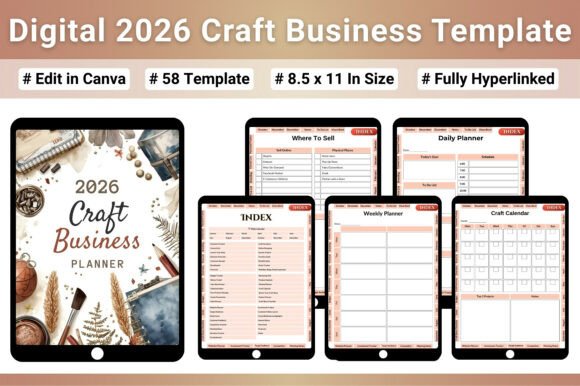
Running a creative business requires more than just talent. Between tracking materials, managing orders, planning product launches, and staying on top of finances, the administrative side of crafting can quickly become overwhelming. The Digital 2026 Craft Business Template — a 58-page fully hyperlinked PDF — was built to solve that exact problem. It offers a structured yet flexible system for handmade sellers, artists, makers, and small business owners who want to keep their work organized without drowning in spreadsheets or sticky notes.
This planner is designed to work the way creative people think. Instead of forcing you into rigid categories, it provides navigable sections for business overview, product planning, inventory, finances, marketing, and seasonal goals. Every page links to related sections, so jumping from your monthly calendar to your product idea tracker takes one click. Whether you use an iPad with GoodNotes, a tablet with Notability, or simply open the PDF on your desktop, the navigation stays smooth and intuitive.
What the Digital 2026 Craft Business Template Actually Does
At its core, this template acts as a command center for your creative business in 2026. The planner includes a full 2026 calendar, year-at-a-glance business planning pages, monthly overviews, and goal-setting sections. It also dives into the specifics of running a craft business: product idea planning, inventory tracking, order management, financial记录, and marketing calendars.
The hyperlinked structure sets it apart from a standard printable planner. Instead of flipping through pages manually, you tap a link in the table of contents and arrive exactly where you need to be. This saves time and keeps you in a productive flow. For anyone juggling multiple sales channels — an Etsy shop, craft fairs, social media storefronts — having one central place to track everything reduces mental load significantly.
Because it is a PDF template, you can reuse it year after year by duplicating the file and clearing entries. The US Letter size (8.5×11 inches) works with most annotation apps and printers, so you can go fully digital or print selected pages if you prefer handwriting your plans.
Why Different People Care About This Planner
The value of a craft business planner shifts depending on who you are and what stage your business is in. A beginner might need help figuring out where to start. An experienced seller might want to streamline existing systems. A part-time creator might prioritize flexibility and low cost. Understanding these differences helps you decide whether this template fits your specific situation.
Beginners: Building a Foundation Without the Overwhelm
If you are new to selling your handmade goods, the sheer number of moving parts can feel paralyzing. You have product ideas floating around, material costs to estimate, pricing to figure out, and no clear way to track what works. The Digital 2026 Craft Business Template gives you a ready-made structure so you do not have to invent one from scratch.
For a beginner, the business vision and mission pages help clarify why you are creating and who you are making for. The product idea planner lets you capture concepts as they come, without worrying about organization yet. The monthly overview pages guide you to set realistic goals — maybe launching one new product per month instead of ten. This gradual approach reduces the risk of burnout and helps you learn what actually sells.
Ease of use matters most here. A hyperlinked PDF that works on a tablet means you can plan while sitting on the couch after a long day at your day job. You do not need special software or design skills to get started.
Experienced Sellers: Refining Systems and Saving Time
For makers who have been selling for a year or more, the challenge is usually not knowing what to do — it is doing everything efficiently. You already have a process for managing orders, tracking inventory, and planning seasonal launches. But maybe your current system involves three different notebooks, a spreadsheet, and a bunch of random notes on your phone.
The appeal of this planner for experienced sellers lies in consolidation. The hyperlinked navigation lets you move between your financial tracker and your marketing calendar instantly. The year-at-a-glance pages help you spot patterns: which months bring the most sales, when to stock up on popular materials, and where your marketing efforts fall short. Over time, this data becomes a strategic asset.
Reliability and speed become priorities. You need a system that does not crash, does not require an internet connection, and opens instantly. A PDF on your device delivers exactly that. You can also customize the template by adding your own pages or duplicating trackers for different product lines.
Part-Time Creators and Side Hustlers: Flexibility Without Commitment
Many creative entrepreneurs run their craft business alongside a full-time job, parenting duties, or other responsibilities. Time is scarce, and every minute spent on admin feels like time taken away from actual making. For this group, the Digital 2026 Craft Business Template offers a low-commitment way to stay organized.
You do not need to use every page. Maybe you only fill out the monthly business overview, the product idea planner, and the order tracker. That is completely fine. The planner adapts to your level of involvement. If you have a slow month, you skip the marketing calendar. If you are preparing for a holiday craft fair, you dive deep into the inventory and financial pages.
Cost is also a practical consideration for side hustlers. A single PDF template that covers an entire year — and can be reused — is far more affordable than subscription-based planning apps or hiring a bookkeeper. The creative value comes from having a system that grows with you, without forcing you into a rigid workflow.
Educators and Workshop Leaders: Teaching Business Skills with Real Tools
If you teach craft business classes, workshops, or online courses, this template can serve as a practical resource for your students. Instead of explaining abstract business concepts, you can walk them through actual planner pages. Show them how to set a goal on the vision page, then track progress on the monthly overview, and finally measure results in the financial section.
The learning value here is substantial. Students see firsthand how planning connects to real outcomes. You can assign the planner as a semester-long project, where each week focuses on a different section. Because the PDF is hyperlinked, students can navigate it easily on their own devices, and you can share tips for using annotation tools like highlighting, text boxes, or stickers.
Flexibility matters for educators. You might want to modify certain pages or add your own prompts. Since the template is a digital file, you can duplicate it, rename sections, or combine it with other resources. This adaptability makes it a versatile teaching aid rather than a rigid textbook.
Different Priorities: What to Consider Before You Buy
No single planner works for everyone. Understanding your own priorities helps you decide whether this template aligns with how you work.
Ease of Use
If you want a system that takes less than ten minutes to set up, this planner delivers. Open the PDF, tap the section you want, and start typing or writing. There are no complex dashboards, no syncing issues, no learning curve. For creators who prefer pen and paper, printing selected pages works just as well.
Cost and Long-Term Value
Compared to monthly subscriptions for business software, a one-time purchase for a reusable PDF template is budget-friendly. You pay once and use it for all of 2026 — and if you clear the entries, you can reuse the structure for future years. This makes it attractive for hobbyists and small businesses with limited budgets.
Quality and Presentation
The planner is designed with a clean, professional look that does not distract from the content. Sections are clearly labeled, fonts are readable, and the hyperlinks work reliably. If presentation matters to you — for example, if you share your planning pages with a mentor, collaborator, or on social media — the visual consistency helps you appear organized and credible.
Flexibility and Customization
Some planners lock you into a specific workflow. This one does not. You can skip pages, add your own, combine it with other tools, or use it only for certain aspects of your business. The template works alongside accounting software, social media schedulers, or inventory apps if you need more depth in those areas. It acts as a central hub rather than a replacement for everything.
Speed and Reliability
Because the file lives on your device, you are not dependent on internet access or server uptime. Open it during a power outage, at a craft fair with spotty WiFi, or while traveling. The hyperlinks respond instantly, and no data syncs to the cloud unless you choose to back it up. For makers who value privacy and control, this offline reliability is a genuine advantage.
Practical Examples for Different Reader Types
Example 1: The Etsy seller launching a spring collection. You use the monthly business overview page to set a March deadline for product photos. The product idea planner helps you refine five new designs. The inventory tracker reminds you to order supplies six weeks ahead. The marketing calendar schedules Instagram posts and Etsy listing updates. By April, you can review sales data in the financial section to see which items performed best.
Example 2: The hobbyist who sells occasionally at local markets. You print only the inventory list, the order tracker, and the monthly overview. You fill them out by hand before each market. After the event, you jot down notes on what sold and what customers asked for. Over the year, you build a simple record that helps you decide which products to make more of.
Example 3: The craft educator teaching a six-week business course. You assign the vision and mission pages in week one, product planning in week two, inventory tracking in week three, and so on. Students share their completed sections in class. The hyperlinked format makes it easy for them to jump back to previous weeks and revise their entries. By the end of the course, each student has a complete business plan ready to execute in 2026.
Example 4: The full-time maker with multiple product lines. You duplicate the PDF for each line — one for candles, one for soaps, one for knit goods. Each file tracks its own inventory, orders, and finances. The year-at-a-glance pages help you compare performance across categories. You spend less time searching for information and more time making decisions based on real data.
Does This Template Match Your Goals?
The Digital 2026 Craft Business Template fits best if you want a straightforward, visual, and portable planning system. It works for people who prefer structure over blank notebooks, but still want room to adapt. It helps if you are comfortable with basic PDF annotation — filling in text fields, adding checkmarks, or using a stylus for handwritten notes.
If you need advanced financial reporting, automated inventory tracking, or team collaboration, you might pair this planner with dedicated software for those tasks. Think of it as the strategic layer where you set direction, track progress, and reflect on results, while more specialized tools handle the tactical execution.
On the other hand, if you barely have time to plan at all, this template reduces the barrier to entry. Open it once a week, fill out a few lines, and let the accumulated data guide you. Over months, those small entries become a valuable record of your business journey.
The template also works well for creative people who want to separate their business planning from their personal life. Having a dedicated file for your craft business creates a mental boundary. When you close the PDF, you stop thinking about inventory counts and marketing schedules, and you can focus on making.
Ultimately, the best planning system is the one you actually use. The Digital 2026 Craft Business Template makes it easy to start, easy to continue, and easy to revisit. If you have ever felt that your creative business could benefit from more clarity and less clutter, this might be the structure you have been looking for.