Smart AI Prompts for Business Marketing
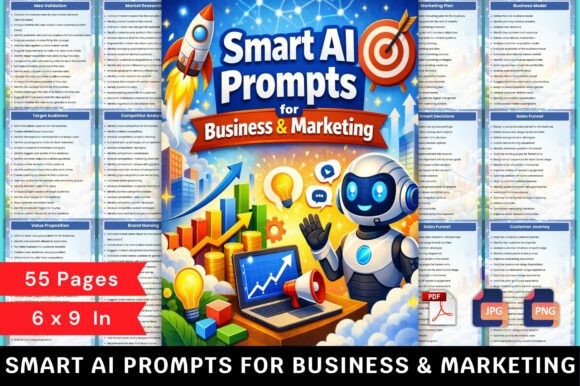
If you’ve ever stared at a blank page trying to plan a marketing campaign or validate a business idea, you know how easy it is to get stuck. The hardest part isn’t the execution—it’s knowing where to start. That’s where a structured prompt library can make the difference between wandering in circles and moving forward with confidence. Smart AI Prompts for Business Marketing is designed to bridge that gap, turning AI into a real thinking partner rather than a novelty tool.
What you get is not a random list of one-liners. Each prompt is built to guide your thinking step by step, helping you uncover gaps, refine strategy, and produce marketing that actually resonates. Whether you’re working alone or leading a small team, these prompts can save hours of second-guessing and help you focus on what matters most.
What makes these prompts different from generic AI instructions
Many people try using AI for marketing by asking vague questions like “Write me a social media post” or “Give me a marketing plan.” The results are often generic and forgettable. Smart AI Prompts for Business Marketing works differently because each prompt is structured to make you think before the AI responds. For example, instead of “Create a content calendar,” you get prompts that ask you to define your audience’s pain points, map their journey, and prioritize channels. The AI then builds on your input, producing something tailored to your actual situation.
This structure matters because businesses—especially small ones—don’t need fluff. They need practical, actionable guidance that fits their unique context. The prompts are designed to be used across different stages, from validating an idea to scaling an existing operation. You can pick the ones relevant to your current challenge and skip the rest.
Launching a new product or service
When you’re about to launch something new, the pressure is on. Will people actually buy? Is the pricing right? Who is the real target audience? The foundation strategy prompts in this collection walk you through market research, competitor analysis, and value proposition development. For example, one prompt asks you to describe the main problem your product solves, then instructs the AI to identify similar solutions in the market and highlight what’s missing. This gives you a clear picture of where your offer fits before you spend time and money on a launch campaign.
A freelancer I know used a similar approach to validate a new online course idea. Instead of guessing, she ran the prompts over a weekend, got AI-generated competitor summaries, and realized her course filled a gap no one else was covering. She adjusted her positioning and pre-sold ten spots before the course was even built.
Planning your marketing strategy
Marketing strategy can feel overwhelming because there are so many moving parts: messaging, channels, budget, timing. The marketing strategy planning prompts break this into manageable pieces. You can start with a high-level marketing plan prompt that asks for your goals, audience, and budget, then drills down into content strategy, funnel design, and campaign calendars. The result is a coherent plan you can actually follow, not a theoretical document that sits in a folder.
One small business owner I spoke with used these prompts to plan a three-month content strategy for her pet product brand. She fed the AI her customer personas and product details, and within an hour had a content calendar with blog topics, social post ideas, and email sequences. She said it would have taken her two weeks to create something similar from scratch.
Refining brand messaging and customer journeys
Your brand message needs to connect with real people, not sound like corporate jargon. The prompts in this section help you define your brand voice, craft a mission statement that stands out, and map the customer journey from awareness to loyalty. For example, a prompt might guide you through identifying emotional triggers for your audience, then ask the AI to rewrite your homepage copy to speak directly to those triggers. The output often surprises you—it’s more human, more specific, and more compelling than what you’d write alone.
A B2B SaaS founder used these prompts to rework his email onboarding sequence. He described his users’ frustrations, and the AI suggested subject lines and body copy that felt conversational instead of salesy. His open rates increased by 30% within two weeks.
Scaling with ads and automation
Growth often requires running ads and setting up automated marketing systems. The prompts cover audience targeting, ad copy variations, landing page optimizations, and automation workflows. Instead of guessing which headline works, you can generate multiple ad copies based on different angles, then test them. The prompts also help you design nurturing sequences that don’t feel robotic.
A creator who sells digital planners used the ad prompts to write ten versions of her Facebook ad copy. She tested three that performed well and eventually found a winner that dropped her cost per conversion by 40%. She then used the automation prompts to set up a welcome series that sent personalized content based on each buyer’s interests.
Solopreneurs and freelancers
When you’re running everything yourself, time is your most limited resource. These prompts let you delegate strategic thinking to AI in a structured way. You can brainstorm ideas, outline content, and plan launches without bouncing ideas off an empty room. The prompts act like a virtual business coach, asking the right questions and helping you see angles you might have missed.
Small marketing teams
Even if you have a couple of people wearing multiple hats, having a shared prompt library ensures consistency in planning and execution. Team members can use the same prompts to generate content or strategies, then compare and refine together. This reduces miscommunication and speeds up workflow.
Founders validating a business concept
Before committing serious money, you want to know if your idea holds water. The business foundation prompts help you research the market, define your niche, and create a value proposition that stands out. Founders who run these prompts early often catch assumptions that would have led them down the wrong path.
Content creators and bloggers
Creating content consistently is tough. The prompts for content strategy and campaign planning give you endless angles for blog posts, videos, social media, and newsletters. Instead of repeating the same formats, you can vary your content based on customer journey stages and platform preferences.
What to consider before using these prompts
Prompts are only as good as the input you give them. If you rush through the questions or provide vague answers, the AI’s output will reflect that. Take time to think about each prompt deeply—the quality of the result depends on the clarity of your thinking. Also, treat the AI’s responses as starting points, not final answers. Always review, edit, and apply your own judgment, especially for sensitive or brand-critical content.
Another thing to keep in mind: these prompts work with any AI language model, but the best results come from models that allow detailed instructions. You may need to experiment with how you phrase your initial context. Some prompts are designed to be run in sequence, so start from the beginning if you want a coherent strategy.
Finally, don’t try to use every prompt at once. Pick the ones most relevant to your current stage. If you’re validating an idea, stick to foundation prompts. If you’re scaling ads, focus on that section. Trying to do everything at once leads to overwhelm, which is exactly what this library aims to reduce.
Real outcome over tool hype
Smart AI Prompts for Business Marketing isn’t a magic button. It’s a structured way to combine your own experience with the speed and breadth of AI. The real value comes when you use the prompts to surface insights you wouldn’t have considered on your own. A prompt asking “What objections might a first-time buyer have?” can reveal concerns you hadn’t thought about. A prompt prompting you to “Describe your competitors’ weaknesses in detail” can shift your positioning overnight.
For many users, the biggest benefit is the shift from reactive to proactive marketing. Instead of constantly reacting to what’s not working, you start planning with intention. You test before you invest. You align your message with what people actually want. That shift, repeated consistently, is what leads to sustainable growth.
Whether you’re a creator testing a new offer, a marketer planning next quarter’s campaigns, or a founder trying to scale without hiring more people, this prompt library gives you a practical starting point. One prompt, one honest answer, one refined output—and suddenly you’re moving faster and smarter than before.